
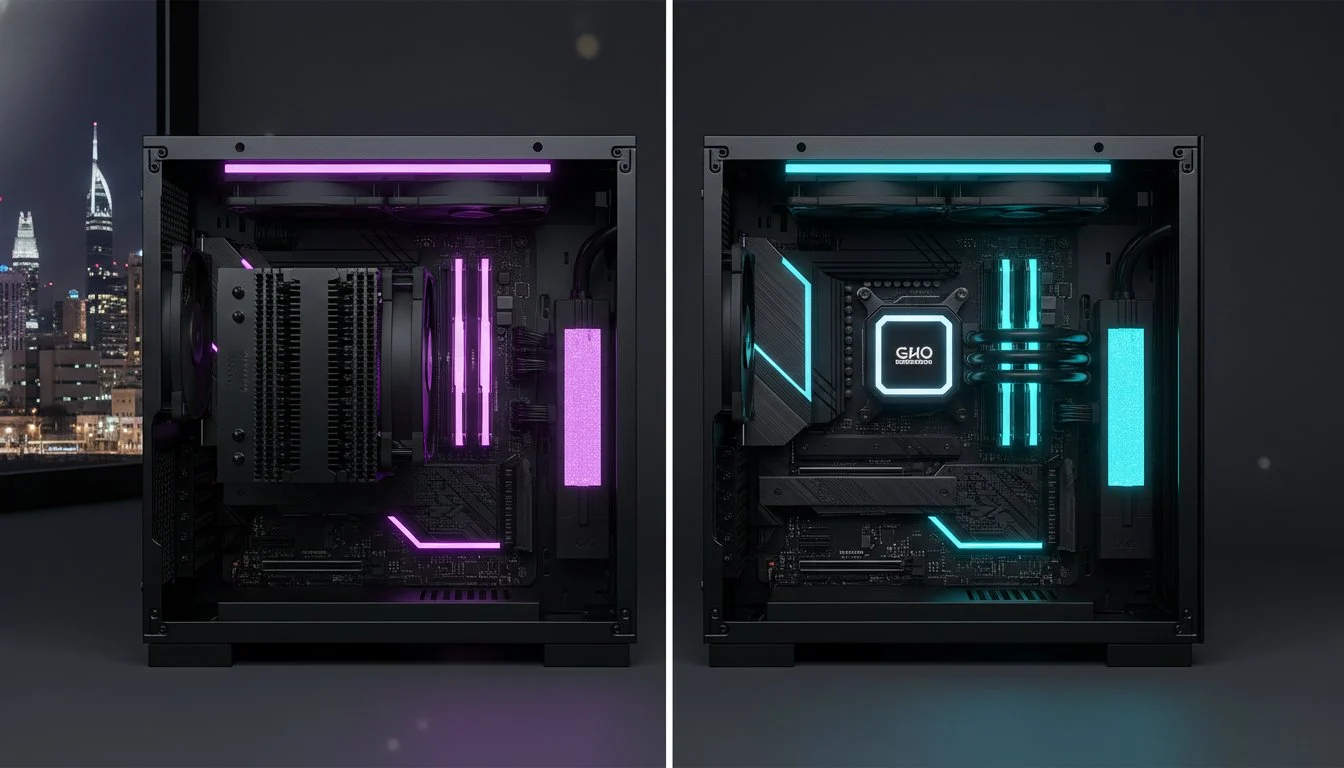

Your high-end silicon is a living engine that breathes heat, and in 2026, mediocre thermal management is the fastest way to kill your productivity. The choice between liquid cooling vs air cooling has shifted from a simple aesthetic preference to a critical performance requirement for anyone running a Core i9 or Ryzen 9 workstation. You’ve probably felt the sting of thermal throttling during a complex 3D render or dealt with the deafening roar of fans in a room already struggling against Bahrain’s high ambient temperatures. It’s a common frustration for creators and gamers who demand peak efficiency from their hardware.
We’re here to help you master the science of PC thermals so you can unlock the true potential of your professional components without the fear of leaks or hardware failure. This guide explores the latest 2026 cooling benchmarks, the impact of new PFAS-free coolant standards, and how to choose the thermal solution that fits the soul of your next bespoke build. We’ll compare the raw reliability of flagship air towers against the superior heat dissipation of modern AIO systems to ensure your machine stays quiet, cool, and incredibly fast.
Key Takeaways
- Identify how the latest 2026 high-TDP processors demand specific thermal solutions to prevent performance-killing throttling during 4K renders.
- Compare the raw thermal performance and acoustic profiles of liquid cooling vs air cooling to find the perfect balance for your workspace.
- Understand the “Bahrain Factor” and why ambient room temperatures dictate the efficiency limit of your chosen CPU cooler.
- Learn to navigate the 2026 regulatory shift toward PFAS-free coolants and how it impacts the longevity of modern liquid loops.
- Discover the Grey PC methodology for stress-testing bespoke builds to ensure absolute stability in extreme regional climates.
Understanding the Thermal Challenge in High-Performance PC Builds
Modern silicon is a masterpiece of engineering, but it’s also a relentless heat generator. By 2026, the landscape of high-performance computing has shifted toward extreme thermal density. Understanding Computer cooling fundamentals is no longer optional for the serious builder; it’s a survival skill. As processors shrink and transistor counts explode, the challenge isn’t just moving heat away; it’s moving it fast enough to prevent the hardware from self-throttling. Heat is relentless. It doesn’t care about your deadlines or your kill-streak.
Thermal throttling is the invisible hand that steals your performance. When your CPU or GPU hits its thermal limit, the system slashes clock speeds to protect the silicon from physical damage. For a professional editor, this turns a smooth 4K render into a grueling, stuttering wait. For a gamer, it means dropped frames during the most intense firefights. The debate of liquid cooling vs air cooling often centers on these specific limits. High-end chips from Intel and AMD now routinely exceed a 250W Thermal Design Power (TDP) under load. This massive energy output requires a cooling solution that can handle sustained thermal pressure without breaking a sweat.
This thermal demand is even more pronounced when you consider the nvidia geforce rtx 5090 for sale. This Blackwell-era beast represents the absolute pinnacle of graphical power, but its sophisticated architecture demands a surgical approach to airflow. You can’t just install a standard fan and hope for the best. You need a strategic thermal plan that accounts for the internal character and heat output of such elite components. Without it, you’re leaving performance on the table.
The Cost of Inefficient Cooling
Poor thermal management does more than just slow you down; it ages your machine prematurely. Excessive heat causes capacitors to degrade and silicon to lose its structural integrity over time. There’s also a psychological price to pay. The constant, high-pitched whine of fans struggling to keep up can destroy the focus of a professional studio environment. Lost productivity is the ultimate tax on inefficient cooling. When heat forces your system to throttle, you aren’t just losing time; you’re losing the competitive edge you paid for.
Thermal Density: The New Frontier
Modern chips are getting smaller, which means more heat is concentrated in a tiny area. This increase in watts per square millimeter makes heat transfer incredibly difficult. The Integrated Heat Spreader (IHS) acts as the first line of defense, but it can only do so much. High thermal density requires precision-engineered contact surfaces to bridge the gap between the silicon and the cooler. The choice between nickel-plated copper or direct-touch heat pipes is dictated entirely by how aggressively a specific chip concentrates its thermal energy across its surface area.
Air Cooling vs. Liquid Cooling: How Modern Systems Manage Heat
The battle for thermal supremacy isn’t won by brute force. It’s won through sophisticated physics. While the previous section highlighted the rising thermal density of 2026 hardware, this is where we look at the mechanical solutions. The core debate of liquid cooling vs air cooling often pits reliability against raw peak performance. Both systems rely on the same fundamental goal: moving heat from the processor die to a surface where it can be dissipated into the atmosphere. However, the medium they use to achieve this determines the character of your entire build.
Choosing the right thermal solution is a transformative step in your assembly process. Whether you’re configuring a workstation for heavy AI datasets or a high-end gaming rig, your choice dictates the machine’s acoustic profile and its ability to sustain boost clocks. For many enthusiasts, Intel’s guide to CPU coolers provides a solid foundation, but the nuances of 2026 hardware require a deeper look into fluid dynamics and phase-change cycles. If you’re looking for a machine where these elements are already perfectly balanced, exploring a Grey PC Custom Build is the most efficient path to peak performance.
The Science of Air Cooling
Modern air coolers are much more than simple metal blocks. High-end towers utilize a sophisticated phase-change cycle hidden within their copper heat pipes. These pipes contain a small amount of liquid that boils when it touches the base plate. The resulting vapor travels to the top of the tower, condenses in the fin stack, and returns via capillary action. This cycle is incredibly fast and reliable. Because there are no mechanical pumps involved, these coolers are often considered “immortal.” As long as the fans are spinning, the cooler is working. The massive fin density of a flagship tower provides a huge surface area for heat dissipation, making it a favorite for those who value long-term stability and zero-maintenance builds.
The Fluid Dynamics of Liquid Cooling
Liquid cooling takes a different approach by utilizing the high thermal mass of water. A pump circulates coolant through a micro-skived cold plate, where it absorbs heat directly from the CPU. This liquid then travels to a radiator. The advantage here is thermal latency; liquid takes much longer to heat up than air, which smooths out temperature spikes during short, intense workloads. Radiator sizing is the critical variable here. A 240mm radiator is standard, but for 2026 flagship chips, 360mm or even 420mm units are necessary to provide the required surface area. The “Leak Myth” has largely been debunked in 2026. Modern All-in-One (AIO) systems use reinforced, multi-layer tubing and industrial-grade seals that make them exceptionally safe for premium hardware.
To maximize either system, static pressure fans are essential. Unlike standard case fans, these are designed to force air through the resistance of dense radiator fins or thick air-tower stacks. Without high static pressure, heat simply lingers, leading to the thermal saturation we discussed earlier. It’s about precision, not just volume.

Performance, Aesthetics, and Longevity: A Direct Comparison
Deciding between liquid cooling vs air cooling is a defining moment for any builder. It sets the tone for your machine’s visual identity and its acoustic footprint. While raw thermal numbers matter, the real-world experience of living with a high-performance workstation involves a delicate balance of noise, looks, and long-term reliability. For many, Intel’s guide to CPU coolers provides a starting point, but we need to look at how these systems behave under the extreme stress of 2026 production workloads. A high-end radiator might dominate in a 3D rendering marathon, but a flagship air tower offers a level of “set and forget” security that many professionals crave.
Under a sustained 100% load, liquid systems generally hold a lead. The massive surface area of a 360mm or 420mm radiator can dissipate heat more efficiently than even the beefiest air-cooled fin stack. This translates to lower peak temperatures during heavy exports. Acoustics are equally vital. High-quality air coolers are nearly silent at idle, but their fans often ramp up aggressively during thermal spikes. Liquid systems maintain a more consistent, low-frequency hum because the liquid acts as a thermal buffer, smoothing out the fan curves. This choice defines the soul of your ultimate gaming pc build. It dictates whether your machine feels like a refined instrument or a raw industrial powerhouse.
The Aesthetic Factor in Custom Builds
Modern builds are as much about art as they are about frames per second. Liquid cooling provides a clean, unobstructed view of your motherboard’s VRM heatsinks and high-speed DDR5 RAM. It creates a sense of space and technical elegance. Conversely, premium air towers from brands like Noctua or BeQuiet offer a “chunky” industrial charm that screams reliability. In a specific chassis like the lian li pc-o11 dynamic, a side-mounted radiator acts as a vibrant canvas for RGB integration, illuminating the entire chamber with a sophisticated glow that air towers simply cannot match.
Reliability and Failure Points
Air cooling is the king of longevity. The only moving part is the fan. If it fails, you simply clip on a new one. This makes it the preferred choice for machines expected to run for a decade. Liquid cooling is more complex. While modern AIOs are incredibly robust, they eventually face the challenge of pump wear or permeation. Permeation is the slow, natural process where liquid molecules escape through the microscopic pores of the rubber tubing over several years, eventually leading to reduced efficiency. For most users, a high-quality AIO will last five to seven years before these factors become relevant. Pairing your cooling solution with a best value graphics card that balances thermal output with price-to-performance ensures your entire build remains efficient and cost-effective for years to come.
The Bahrain Factor: Cooling in Extreme Ambient Temperatures
Most global hardware guides are written for temperate climates where a 22°C room is the standard. In the Middle East, your ambient temperature is the “thermal floor” for your entire system. If your office or studio sits at 28°C, your components are already starting at a massive disadvantage compared to lab benchmarks. This is where the debate of liquid cooling vs air cooling becomes a matter of regional survival. Air coolers rely on the temperature difference (Delta-T) between the heatsink and the air being pushed through it. When that air is already warm, the heatsink reaches thermal saturation much faster, leading to the aggressive throttling we discussed earlier. Heat is relentless. It doesn’t wait for your render to finish.
Liquid cooling offers a distinct advantage in these high-ambient scenarios. A 360mm or 420mm radiator provides a larger thermal buffer, allowing the system to absorb heat spikes more effectively before the fans have to hit maximum RPM. Keep in mind that high-performance cooling setups, especially those with multiple high-static pressure fans and powerful pumps, increase your total system power draw. To ensure your rig doesn’t stumble under peak load, you must verify your psu requirements for rtx 4090 or other flagship GPUs. Stability starts with a rock-solid power supply.
Dust and Humidity Management
Regional dust is fine, abrasive, and everywhere. It acts as a thermal insulator, trapping heat within your radiator fins or air-cooler stacks. In Bahrain, we recommend a strict cleaning schedule; you should be dusting your internals twice as often as a user in a cooler, less dusty climate. We combat this by utilizing positive pressure configurations. By having more intake fans than exhaust fans, and ensuring all intakes are filtered, we force air out of every small gap in the chassis. This prevents dust from being sucked into the machine through unshielded seams and ports.
Case Airflow: The Silent Partner
A premium cooler is useless if it’s trapped in a glass box with no air. For 2026 high-performance builds, high-airflow mesh panels are mandatory. We design our airflow paths to create a “wind tunnel” effect, moving cool air directly across the motherboard VRMs and the GPU backplate. Optimizing your fan curves is a transformative experience. You want enough airflow to keep the Delta-T low without creating a vacuum that pulls in every grain of sand from the surrounding environment. It’s about precision engineering, not just adding more fans.
Ready to build a machine that defies the heat? Explore our Grey PC Custom Build options designed specifically for peak performance in extreme climates.
Bespoke Thermal Engineering: The Grey PC Approach
At Grey PC, we view thermal management as a transformative experience rather than a simple mechanical task. We don’t just install parts; we engineer environments where silicon can reach its absolute zenith. Every Grey PC Custom Build undergoes proprietary stress-testing designed for the reality of our regional climate. While standard benchmarks assume a cool European office, our builds are pushed to the limit in conditions that mirror the high ambient temperatures of Bahrain. This ensures your machine maintains its “thermal soul” even during the most demanding 48-hour 3D render or a marathon competitive gaming session.
The choice of liquid cooling vs air cooling is never a one-size-fits-all decision in our studio. We match the cooling architecture to your specific professional identity. For 3D artists running sustained, multi-hour workloads on a 3D Rendering Workstation, we often lean toward high-surface-area liquid loops to manage heat soak. For competitive gamers who prioritize absolute reliability and zero-maintenance longevity, a flagship air tower often provides the best path. Our secret weapon lies in professional tuning; we meticulously craft custom fan curves and utilize precision undervolting to reduce heat output without sacrificing a single megahertz of clock speed.
Expert Consultation and Assembly
Our builders select the heart and soul of your machine based on your exact workflow. Precision is our hallmark. This extends to professional cable management, which we treat as a functional necessity for unobstructed airflow. When you compare a liquid cooling vs air cooling setup, the internal geometry of the case matters. A clean, expertly routed interior ensures that fresh air reaches the GPU and VRMs without turbulence. This commitment to thermal headroom is why our custom gaming desktop vs gaming laptop Bahrain guide highlights the superior performance ceiling of a dedicated desktop tower.
Lifetime Support and Maintenance
Precision engineering requires consistent care. We provide professional cleaning and servicing to ensure your cooling system remains as efficient as the day it was built. Whether you need to dust a complex fin stack or monitor the health of a liquid pump, our team is your long-term partner. As you evolve into the Blackwell era and beyond, we help you upgrade your thermal solutions to match the escalating demands of next-generation hardware. Your machine is an investment in your craft, and we treat it with the respect it deserves.
Don’t settle for mass-produced compromises. Build your god-tier thermal solution with Grey PC today.
Master the Thermal Soul of Your Next Build
The 2026 hardware landscape doesn’t forgive thermal negligence. Whether you’re pushing a workstation through complex AI datasets or dominating a 240Hz+ gaming arena, your choice in liquid cooling vs air cooling defines your machine’s peak potential. We’ve explored how high-TDP components like the Blackwell-era GPUs demand a surgical approach to heat dissipation. You now understand that while air towers offer legendary reliability, modern liquid loops provide the essential thermal buffer needed for sustained 3D rendering in our regional climate. Precision matters when every degree counts.
Managing the delicate balance between acoustics, aesthetics, and performance is a transformative experience that requires deep technical expertise. Our team specializes in high-TDP thermal management and professional hardware servicing right here in Bahrain. We don’t just assemble parts; we tune the soul of your technology to ensure it thrives under pressure. It’s time to move beyond standard retail solutions and embrace bespoke engineering that respects the internal character of your hardware.
Design your custom high-performance rig with Grey PC’s thermal experts and unlock the true power of your investment today. Your next god-tier build deserves nothing less than absolute precision.
Frequently Asked Questions
Is liquid cooling better than air cooling for gaming in Bahrain?
Liquid cooling provides a significant advantage in Bahrain because it offers a larger thermal buffer against high ambient temperatures. While air coolers struggle as the thermal floor of your room rises, liquid systems dissipate heat more efficiently through larger radiator surface areas. This helps maintain stable boost clocks during long gaming sessions in our regional climate where heat is relentless.
Can a liquid cooler leak and destroy my PC?
Catastrophic leaks are extremely rare with modern All-in-One (AIO) systems in 2026. Manufacturers now utilize reinforced multi-layer tubing and industrial grade seals to ensure absolute safety for your premium components. While no mechanical system is completely infallible, the risk is negligible compared to the massive performance benefits for high-end hardware.
How often do I need to replace the coolant in an AIO liquid cooler?
You don’t need to replace the coolant in an AIO because they are factory sealed, closed loop systems. Most high quality units are designed to last five to seven years without any internal maintenance. After this period, natural permeation and pump wear usually mean it’s time to replace the entire unit rather than attempting to refill it.
Will a large air cooler fit in any PC case?
No, premium air towers often require specific clearance for both height and RAM modules. Flagship coolers can stand over 165mm tall, which exceeds the width of many budget or compact chassis. Always check your case specifications and motherboard layout to ensure your chosen tower doesn’t obstruct your memory slots or hit the side panel.
Does liquid cooling make the PC quieter than air cooling?
Liquid cooling is generally quieter during intense workloads because the liquid absorbs heat spikes, allowing fans to ramp up more gradually. In the liquid cooling vs air cooling debate, acoustics are a major factor for studio professionals. While air coolers can be silent at idle, they often produce more noise when trying to dissipate heat from high TDP processors under load.
Do I need liquid cooling for an Intel i9 or Ryzen 9 processor?
Liquid cooling is highly recommended for i9 and Ryzen 9 chips because their power draw often exceeds 250W under heavy stress. These elite processors generate massive heat density that can quickly overwhelm even the best air coolers. Using a 360mm or 420mm AIO ensures you get the full performance you paid for without constant thermal throttling.
What happens if my PC cooler fails while I’m using it?
Your system won’t immediately explode; modern CPUs have built-in thermal protection that triggers a shutdown if temperatures exceed safe limits. You’ll notice extreme stuttering or a sudden black screen as the hardware protects its internal silicon. If this happens, stop using the PC immediately and have the pump or fan inspected by a specialist to avoid long term damage.
Is air cooling enough for an RTX 4090 or RTX 5090 build?
Air cooling can work for these flagship GPUs, but only if you use a high airflow mesh case with exceptional intake. The liquid cooling vs air cooling choice for an RTX 5090 build is critical because these cards produce immense heat that can saturate the internal air of a small case. We often recommend liquid solutions to exhaust that heat directly out of the chassis for better stability. Before finalizing your build, reviewing our guide to the best value graphics card in 2026 can help you identify which GPU tier delivers the optimal price-to-performance ratio without unnecessarily inflating your thermal load.